
It usually starts with a good problem. Your posts get traction, the messages pile up, and suddenly your phone is the busiest part of your business. “Price?” “Is this available in black?” “Can you deliver to Jahra tomorrow?” Each conversation is a potential sale, and each one also takes five, ten, fifteen minutes of your day. At some point every growing seller asks the same thing: is it time for an online store for Instagram sellers like me, or is the inbox still good enough?
This guide is written for small businesses in Kuwait that take orders through Instagram direct messages and WhatsApp. It covers the signs that message-based selling has started costing you more than it earns, what a store of your own actually changes in your daily routine, what should stay on Instagram, and how to make the move without losing the customers who already know where to find you.
Signs That Message Orders Are Costing You Time and Sales
Selling through direct messages works well at the beginning because it is personal and fast to set up. The cost only becomes visible as volume grows, and it rarely shows up as a single dramatic failure. It creeps in as repeated questions, missed replies, and evenings spent copying addresses into a notebook.
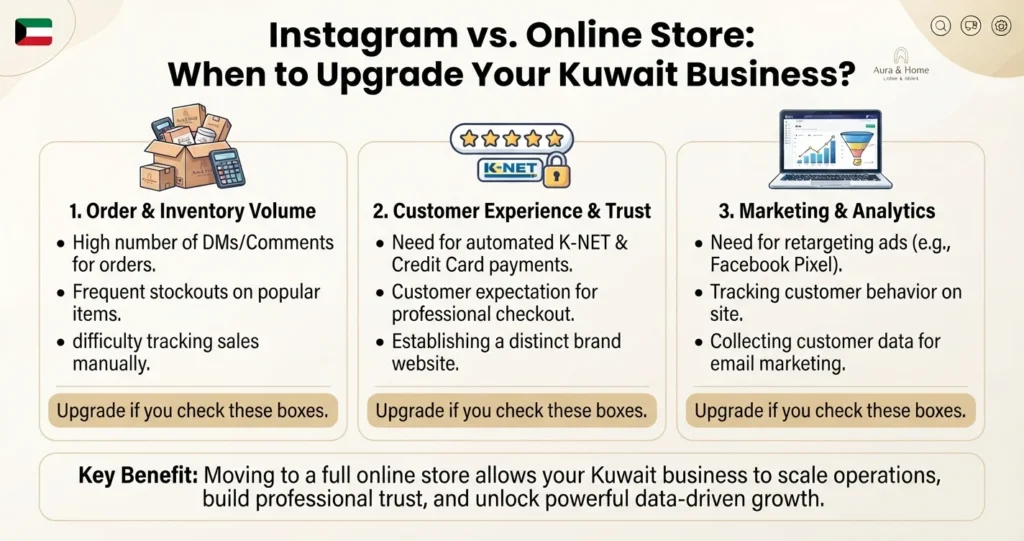
The clearest signal is repetition. If you answer the same five questions about price, sizes, colours, delivery areas, and payment dozens of times a day, you are doing by hand what a product page does automatically. A second signal is the late-night gap. Customers browse after work and after dinner, and if a reply comes the next morning, some of them have already bought elsewhere. You never see those lost sales in your inbox, which makes them easy to underestimate.
Watch, too, for operational mistakes. Selling the same last item to two people, sending the wrong size, mixing up addresses, or forgetting to confirm a payment are all symptoms of a system held together by memory and screenshots. If any of these happen more than occasionally, you have outgrown the inbox.
- Repetition: most messages ask questions a product page could answer.
- Delay: orders arrive when you cannot reply, and some go cold.
- Errors: double-selling, wrong sizes, or lost delivery details.
- Payment chasing: time spent confirming transfers and links.
- No overview: you cannot say quickly what sold best last month.
Two or three of these together is usually the point where an online store for Instagram sellers starts paying for itself in time saved alone.
What an Online Store for Instagram Sellers Actually Changes?
A store does not replace your relationship with customers. It takes over the mechanical parts of each sale, so the conversations you do have are about service and recommendations rather than “how much is delivery to Salmiya?” Here is where the difference shows up day to day.
Payment and Delivery
When a customer can pay at checkout, the payment step stops being a separate conversation. KNET is Kuwait’s national debit network and a familiar option for local shoppers, and many also pay by credit card, so a store should offer the methods your buyers already trust. Setting that up involves a payment gateway agreement and some technical integration; our guide to KNET payment gateway questions walks through what to ask a provider before you sign.
Delivery becomes structured as well. Instead of typing out areas and fees in every chat, you set delivery zones and charges once. The customer enters the address in a form with block, street, and house fields, the total updates automatically, and you receive the order with every detail in the same place. That single change removes a surprising share of daily back-and-forth.
Orders and Stock
An order management screen shows every order, its payment status, and its delivery status on one page. You can mark items as packed or shipped, search past orders when a customer gets in touch, and export the list for your courier. Compare that with scrolling up through hundreds of chats to find what someone ordered three weeks ago.
Stock control is the other quiet benefit. Each product and variant has a quantity, which drops automatically with each sale. When the last medium in navy sells, it shows as unavailable, and nobody else can buy it. For sellers who have ever had to apologise for selling an item they no longer had, this alone can justify the move.
Why an Online Store for Instagram Sellers Gets Found on Google?
Conversations in your inbox are invisible to search engines. Product pages are not. A well-built store with clear product names, descriptions, and photos can show up when people search for what you sell, including people who have never seen your Instagram account. Google explains that when you add product structured data to your pages, your product information can appear in richer ways in Google Search results, and for pages where customers can buy, merchant listings can highlight details such as price, availability, shipping and return information. That is a channel no inbox can give you.
What Stays on Instagram After You Move?
Moving to a store is not leaving Instagram. For most small Kuwaiti brands, Instagram remains the main place where people discover new products, see them styled, and decide they want them. The store simply becomes the place where the buying happens.
Keep posting, keep running stories, and keep replying to messages, especially questions about fit, gifting, or custom requests where a personal answer wins the sale. What changes is the call to action. Instead of “DM to order”, posts and stories point to a product link or the link in your bio. If your profile is not yet set up to drive that traffic well, our Instagram business profile setup checklist covers the essentials, and a steady posting rhythm matters more than ever once each post can send people straight to a product page. Our planned Instagram content plan template will help with that.
Many sellers also keep WhatsApp as a support channel after launch. That is sensible. A visible WhatsApp button on the store reassures first-time buyers that a real person is available, while the store handles the routine steps.
The Content and Photos a Store Needs
The biggest surprise for many sellers is how much content an online store for Instagram sellers needs compared with an Instagram grid. On Instagram, a great photo and a short caption can carry a product. On a store, each product page has to answer every question a customer would otherwise message you about.
That means a clear product name, a description that covers materials, sizes or dimensions, and care instructions, several photos from different angles on a clean background, and accurate prices for every variant. If your audience reads both languages, plan for product information in Arabic and English from the start rather than adding one later. You will also need short pages for delivery, returns, and contact details, written in plain language.
Start by preparing this content for your best-selling twenty or thirty products rather than the whole range. A small catalogue with complete, well-photographed pages sells better than a large one with half-empty listings, and you can add the rest over the following weeks.
How to Move From Instagram to a Website Without Losing Customers?
The safest way to move from Instagram to a website is to treat it as a gradual transition rather than a switch you flip overnight. Your existing customers are used to messaging you, and they should still be able to do that while they get comfortable with the new way of ordering.
Begin by choosing a platform that fits your size and plans. A hosted platform, an open-source system such as WooCommerce, and a custom build each suit different situations; our planned guide on choosing an ecommerce platform in Kuwait compares them. Next, set up payments, delivery zones, and your policy pages, then load your top products and place a few real test orders yourself, including a refund, before announcing anything.
When the store is ready, tell your followers clearly and repeatedly. Pin a story highlight that explains how to order, update your bio link, and for the first few weeks reply to DM orders with a friendly message and a direct product link instead of taking the order by hand. Most customers switch quickly once they see how easy it is, and the ones who prefer messaging can still reach you.
Consider an illustrative example. A home-based abaya seller receives around forty order messages on a busy day and spends most evenings confirming sizes and addresses. After launching a store with her twenty best-selling designs, she keeps posting on Instagram but links every post to the product page. Questions about fabric and fit still arrive by message, but the routine steps of price, size selection, address, and payment now happen at checkout. The evenings she used to spend on admin become time for new designs. Your results will depend on your products and audience, but that shift from typing to selling is the point of the move.
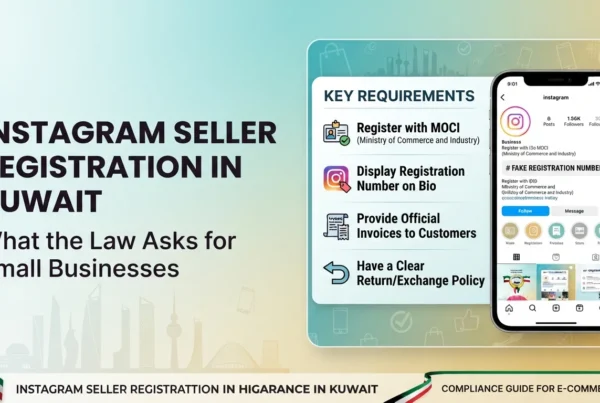
Before you launch, it is also worth checking which seller information and registration steps apply to your business. We cover that separately in our guides to Instagram seller registration in Kuwait and what an online store must show under Kuwait’s digital commerce law.
Questions to Ask Before You Create an Online Store in Kuwait
A few honest questions will tell you whether you are ready to create an online store in Kuwait now or whether it makes sense to wait a little longer. How many orders do you handle in a typical week, and how many hours do they take? Do you have consistent stock, or does most of what you sell exist in one-off quantities? Can you produce product photos and descriptions for your main range in the next month? Who will update products, process orders, and answer customers once the store is live?
Ask any developer or agency you speak to how payments will be integrated, whether the store will work well on mobile phones, who owns the domain and the customer data, how you will add products yourself, and what support looks like after launch. Clear answers to those questions matter more than a long list of features.
Frequently Asked Questions
Most sellers reach that point when order messages take hours of their day, mistakes such as double-selling or wrong addresses start appearing, or customers wait too long for replies. If your stock is steady and you have products that sell repeatedly, an online store for Instagram sellers usually saves time quickly and gives you a sales channel that works while you are offline.
In the short term, saved replies, a price list highlight, and a simple order spreadsheet help. In the longer term, the most effective step is to take orders online through a store, so customers choose products, enter addresses, and pay at checkout, while messages are kept for questions that genuinely need a personal answer.
Yes, a store can accept KNET once it is connected to a payment gateway that supports it. That typically involves an agreement with a bank or payment provider and technical integration with your store platform. Ask providers about fees, settlement times, and the documents they need before you commit.
It works best as a partner to Instagram rather than a replacement for it. Instagram keeps doing what it does well, which is discovery and engagement, while the store handles product information, checkout, payments, and order records. Used together, they cover the full journey from first look to delivery.
Ready to Stop Taking Orders by Hand?
If your inbox has become your order system, you already know what it costs in time and missed sales. An online store for Instagram sellers keeps everything that works about selling on Instagram and takes over the repetitive parts, so you can spend your day on products, customers, and growth rather than copying addresses.
Our e-commerce store development in Kuwait service helps small businesses plan, build, and launch stores with local payment options, delivery settings, and product pages ready for both customers and search engines. Request a quote for your project, tell us how you sell today, and we will suggest a setup that fits where your business is now.