

“How much should we spend on Google Ads?” It is usually the first question a business owner asks, and the answer they most often get is a round number pulled from thin air. Some agencies suggest a figure that happens to match their minimum. Some owners pick whatever feels affordable this month. Neither approach tells you whether the money can realistically produce customers. Setting a Google Ads budget in Kuwait works far better when you start from the result you want and work backwards to the spend.
This guide gives you a simple method you can use before launching a single campaign. You will learn how to turn a lead target into a monthly budget, how to use Google’s Keyword Planner to estimate costs for your own keywords, why agency fees should always be quoted apart from ad spend, and what to measure in the first sixty days so you can decide whether to scale, adjust, or stop.
Your Google Ads Budget in Kuwait Starts With a Lead Target
A budget is not a goal. It is the cost of reaching a goal. So before you think about dinars, decide what a successful month looks like in business terms. For a clinic, that might be booked appointments. For a B2B supplier, quote requests. For an online store, orders at a profitable average basket.
Be specific. “More customers” cannot be turned into a budget, but “thirty qualified enquiries a month for our office fit-out service” can. Then ask how much one of those enquiries is worth to you. If one in five enquiries becomes a contract, and a typical contract earns you a healthy margin, you can work out the most you can afford to pay for a single lead and still make money. That ceiling is the number that matters most, because it tells you whether paid search can work for your business at all.
This step also forces a useful conversation about tracking. If you cannot count leads today, you will not be able to judge your ads tomorrow. Make sure form submissions, phone clicks and WhatsApp clicks are recorded before launch; our guide to GA4 key events for lead generation explains how.
The Google Ads Budget Formula
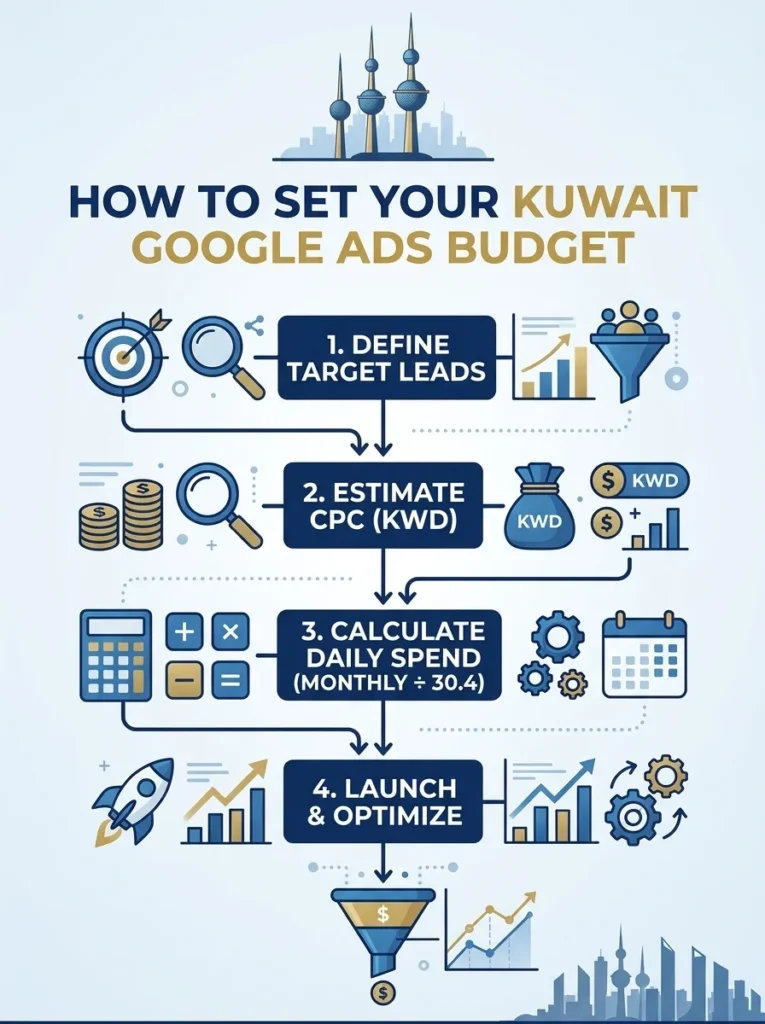
Once you have a lead target, the arithmetic is straightforward. Three numbers connect your target to your spend: how many clicks you need, what share of those clicks become leads, and what each click costs.
The formula looks like this: monthly ad spend = (lead target ÷ conversion rate) × average cost per click. Divide your lead target by your expected conversion rate to get the number of clicks you need. Multiply those clicks by the average cost per click to get the spend. Divide the spend by your lead target, and you have your expected cost per lead.
Clicks, Conversion Rate and Cost per Lead: An Illustrative Example
The figures below are invented for easy arithmetic. They are not benchmarks for Kuwait or for any industry, and your own numbers will differ.
Suppose a company wants 30 enquiries a month. Its landing page is expected to convert 5% of visitors into enquiries, so it needs 30 ÷ 0.05 = 600 clicks. If Keyword Planner suggests an average cost of 0.50 KWD per click for its chosen keywords, the monthly ad spend is 600 × 0.50 = 300 KWD, and the expected cost per lead is 300 ÷ 30 = 10 KWD. Google Ads budgets are set per day, and Google’s guidance is to divide a monthly amount by 30.4, the average number of days in a month, so the campaign would run at roughly 9.87 KWD a day.
Now test the result against your ceiling. If a lead is worth paying up to 25 KWD for, a 10 KWD estimate leaves room for error. If your ceiling is 8 KWD, the plan does not work as it stands, and you would need a better-converting landing page, cheaper keywords, or a different channel. That single comparison saves many businesses from spending months on campaigns that were never going to pay off.
Using Keyword Planner to Estimate Google Ads Cost in Kuwait
The weakest part of most plans for a Google Ads budget in Kuwait is the cost-per-click guess. Rather than relying on someone else’s averages, use Google’s own estimates for your keywords, in your location. Inside your Google Ads account, open Keyword Planner from the Tools menu and select “Get search volume and forecasts”, then enter or upload your keyword list. Set the location to Kuwait and add both English and Arabic keywords, since many local buyers search in Arabic and the costs can differ between the two languages.
Google explains that Keyword Planner draws on historical search data to estimate what a set of keywords might produce at a given spend. Treat those figures as a starting range rather than a promise. Low-volume keywords may show little data, and newer accounts receive more generic estimates. The forecast becomes far more reliable once your own campaign has a few weeks of real clicks.
Two practical tips. First, look at the “top of page bid” range for each keyword rather than one average, because competitive terms can sit well above the mean. Second, group keywords by intent. Searches that include words like “price”, “company” or “near me” usually signal buyers who are ready to act, and they deserve more of your PPC budget planning than broad research terms.
Google Ads Management Fee Versus Ad Spend
When you request quotes, you will usually see two separate costs, and keeping them apart is essential. Ad spend is the money paid to Google for clicks. It goes directly to Google, usually charged to your own card or invoice. The Google Ads management fee is what you pay an agency or freelancer for research, setup, ad writing, testing, optimisation and reporting.
A clear quote shows both figures on separate lines, and you should be wary of proposals that bundle them into a single “package” number. Bundling makes it impossible to see how much of your money actually reaches Google. It also hides whether the agency’s fee rises as your spend rises, which is common with percentage-of-spend pricing. Neither a flat fee nor a percentage is wrong in itself; the point is that you should know exactly which one you are paying.
Ask any Google Ads agency in Kuwait you are considering whether the account will be created under your ownership, so you keep the history and data if you move on. An account you own is worth more than it looks, because the performance history inside it makes future campaigns easier to plan.
How to Start Small and Scale Your Google Ads Budget in Kuwait
The safest way to launch is to spend enough to learn, but not so much that mistakes become expensive. A tight first campaign focused on your highest-intent keywords, one service, and one well-built landing page will teach you more than a broad campaign spread thinly across everything you offer.
Google’s budget mechanics are worth understanding at this stage. On a busy day, a campaign can spend more than its daily setting; Google says that for most campaigns you will pay no more than two times your average daily budget on any day, and 30.4 times it in a month. So a 10 KWD daily budget will not quietly turn into a 600 KWD month, but daily spend will vary, and that is normal.
Plan for seasonality too. Search behaviour in Kuwait shifts around Ramadan, Eid and the national holidays in February, and demand for many services changes over the summer. If you know a busy season is coming, plan the increase in advance rather than reacting once competitors have already raised their bids. Our guide to planning Kuwait National Day campaigns covers one of those peaks.
When the numbers work, scale gradually. Raise budgets in steps, watch whether the cost per lead holds, and expand to new keywords or services only after the first campaign is stable. If you are still deciding between search ads and social platforms for that first test, our planned comparison of Google Ads vs social media ads will help you choose.
What to Measure in the First 60 Days?
The first two months of any Google Ads budget in Kuwait are about learning whether your assumptions were right. Each figure in your budget formula was a guess at launch, and now you can replace each guess with real data.
- Actual cost per click compared with the Keyword Planner estimate.
- Landing page conversion rate: are visitors turning into leads at the rate you assumed?
- Cost per lead compared with the ceiling you calculated.
- Lead quality: how many enquiries are genuine prospects rather than job seekers or wrong-fit requests?
- Search terms report: which real searches triggered your ads, and which should be excluded.
Of all these, lead quality is the one most often ignored. Twenty leads at 12 KWD each that produce four contracts beat forty leads at 6 KWD each that produce none. Ask your sales team to mark each enquiry, even roughly, so the campaign can be judged on revenue rather than form counts. A good monthly report should show all of this clearly; our planned guide to what an ads performance report should include explains what to expect.
Mistakes That Waste a Google Ads Budget
Most wasted spend comes from a short list of avoidable errors. The first is sending clicks to a homepage instead of a page built for the ad’s promise. A visitor who searched for a specific service and lands on a general homepage often leaves within seconds. Our ad landing page checklist shows what that page needs.
The second is targeting too broadly: running ads across the whole country at all hours, on every device, for loose keyword matches, before the data justifies it. The third is ignoring negative keywords, which lets your ads appear for searches that have nothing to do with buying. The fourth is choosing a campaign type before understanding what each one is designed for; our planned guide to Performance Max vs search campaigns explains the trade-offs. And the fifth is judging results after a week. A week of data is noise. Give a campaign at least a few weeks of steady spend before making major changes.
Frequently Asked Questions
Work it out from your lead target rather than a round number. Divide the leads you want by your expected conversion rate to get the clicks you need, then multiply by the average cost per click from Keyword Planner. Compare the resulting cost per lead with what a lead is worth to you. If the numbers work, that figure is your starting Google Ads budget in Kuwait.
Ad spend is paid to Google for clicks on your ads. The agency fee pays for the people who plan, build, optimise and report on your campaigns. They should appear as separate lines in any quote so you can see exactly how much reaches Google and how the fee is calculated.
Divide your total ad spend for a period by the number of leads it produced. If a campaign spent 300 KWD in a month and generated 30 tracked enquiries, the cost per lead is 10 KWD (illustrative figures). Include only tracked, genuine leads, and compare the result with the most you can afford to pay per lead.
Google lets you set your own average daily budget, so there is no fixed minimum you must spend to advertise. In practice, though, a budget that is too small produces so few clicks that you cannot learn anything useful. Use the formula to find the spend needed to reach a meaningful number of leads, and treat that as your realistic starting point.
Plan Your Budget Before You Spend It
A reliable Google Ads budget in Kuwait is built, not guessed. Start with the leads you need, estimate costs with your own keywords, keep the management fee separate from the money that goes to Google, and let the first sixty days replace your assumptions with real data. Do that, and every dinar you spend has a job to do and a way to be measured.
If you would like help building that plan, our Google Ads management (SEM) team can research your keywords in Arabic and English, model a realistic budget, and set up tracking before launch. Request a quote for your project, and we will show ad spend and management fees on separate lines so you know exactly where your money goes.